
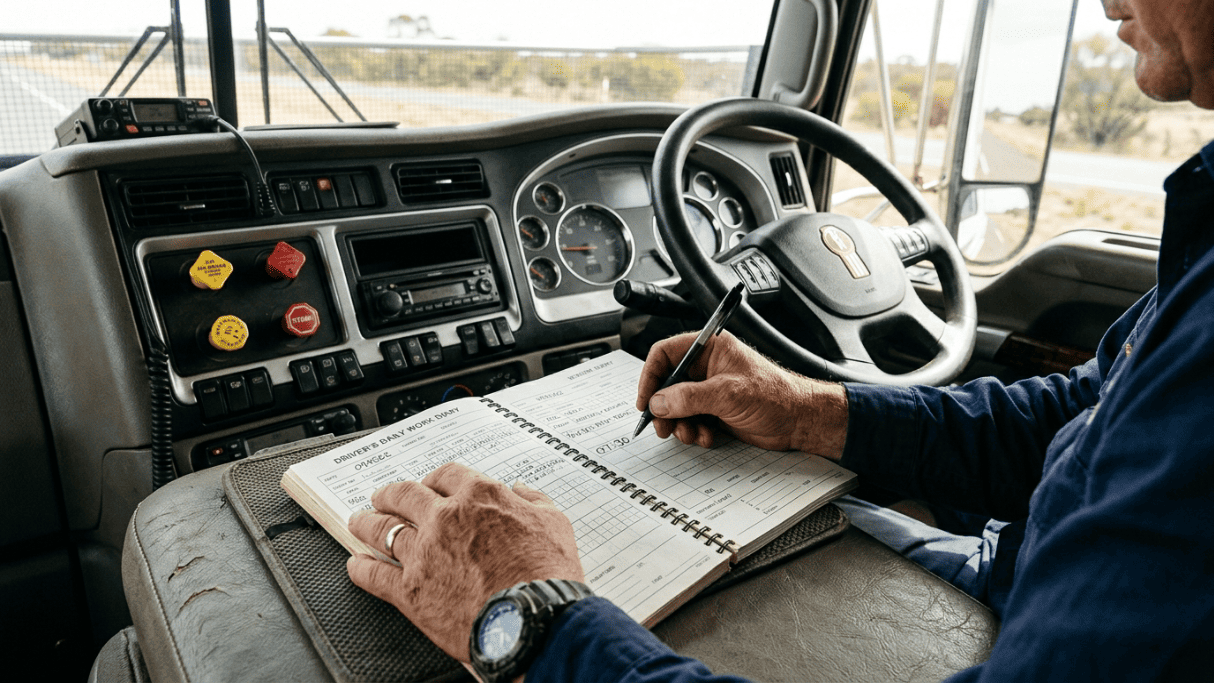
If you’re looking at starting a career behind the wheel of a truck, there’s a good chance you’ve asked: do I need a log book for medium rigid truck driving in Western Australia?
It’s one of the more common questions we get, and the answer surprises most people. WA plays by its own rules when it comes to fatigue management, and the national log book requirements you’ve probably read about online don’t apply the same way here.
In this guide, we’ll explain when a work record is required for an MR truck in WA, who actually regulates heavy vehicle fatigue in this state, and – more importantly – why most drivers should skip the MR licence altogether and go straight to a Heavy Rigid (HR) licence instead.
The Short Answer: No, Not for an MR Truck in WA
If you’re driving a Medium Rigid truck inside Western Australia, you do not need to carry a National Driver Work Diary. The formal log book system people picture when they hear “truck driver log book” is a national scheme, and WA has opted out of it.
Who Actually Governs Fatigue in Western Australia
Here’s where a lot of online advice gets it wrong. Most articles refer to the National Heavy Vehicle Regulator (NHVR) and the Heavy Vehicle National Law. That framework covers the eastern states — it does not apply in WA.
In Western Australia, heavy vehicle fatigue is regulated through two bodies:
- Main Roads WA – handles heavy vehicle accreditation, including the Fatigue Management Module that operators can opt into as part of WA Heavy Vehicle Accreditation.
- WorkSafe WA – enforces the core fatigue rules for commercial drivers under the Work Health and Safety (General) Regulations 2022, Part 4.10, supported by the Code of Practice: Fatigue Management for Commercial Vehicle Drivers.
So when someone asks about a log book for MR truck driving in WA, the honest answer is that a national-style work diary isn’t what applies – a WA work record and compliance with WorkSafe’s fatigue code is.
When a National Driver Work Diary Does Apply to WA Drivers
There’s one scenario where the national work diary comes back into play: crossing the border.
A National Driver Work Diary must be carried and completed if you’re driving:
- A vehicle or combination weighing more than 12 tonnes GVM, or a bus designed to carry more than 12 adults (including the driver), and
- Travelling outside Western Australia and the Northern Territory
If you’re hauling from Perth to Adelaide in a vehicle that fits that description, you’ll need to complete the diary for trips more than 100 km from your driver base. But if you’re running freight around Perth, Bunbury or Kalgoorlie in an MR or HR truck, the national log book simply isn’t required.
What WA Drivers Need to Record Instead
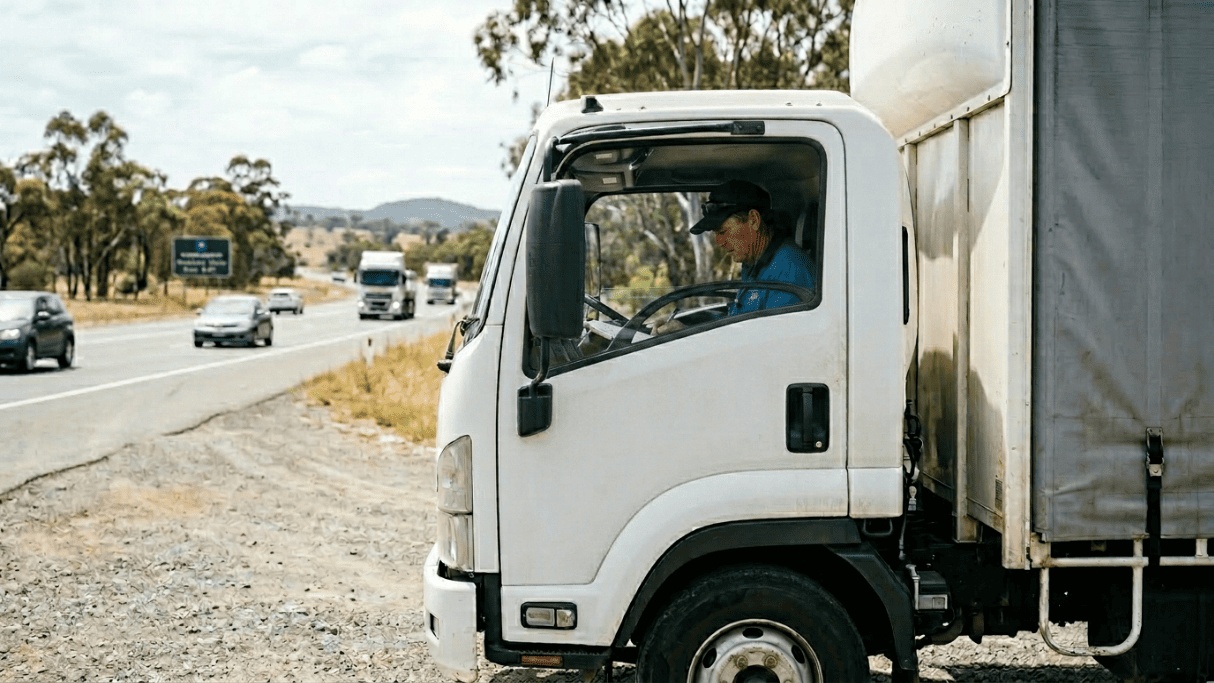
Even without the national work diary, WA drivers operating a commercial vehicle over 4.5 tonnes GVM for hire or reward are expected to comply with WorkSafe’s fatigue rules. In practice that means:
- No more than 168 hours of work time in any 14-day period
- At least 27 hours of non-work time in any 72-hour period, including three breaks of at least 7 continuous hours
- No more than 17 hours between non-work periods of at least 7 continuous hours
- At least two periods of 24 continuous hours of non-work time in any 14-day period
Operators and drivers need to keep a work/driving record that demonstrates they’re meeting those limits. It’s not a formatted work diary booklet like the NHVR version, it’s a record your business maintains as part of its fatigue management system.
Why We’d Steer You Toward an HR Licence Instead
Now for the part that saves most of our students time, money and headaches down the track.
In WA, the MR and HR licensing processes are almost identical. Same theory component. Same style of practical driving assessment. Same commitment from you. The main differences are:
- MR covers two-axle rigid trucks with a GVM over 8 tonnes. You need to have held a C-class licence for 1 year.
- HR covers three-axle rigid trucks with a GVM over 8 tonnes. You need to have held a C-class licence for 2 years (or an LR/MR licence for 12 months).
So the “extra axle” is really the only meaningful difference between the two trucks. The vehicles behave similarly, the test style is comparable, and the effort involved in training is on par.
The career difference, though, is enormous. Here’s why most of our students go straight to a heavy rigid licence Perth course:
An HR licence covers MR vehicles too
Get your HR and you can drive anything an MR licence covers, plus three-axle rigids. An MR licence doesn’t work in reverse.
More job opportunities
HR is the most in-demand truck licence class in Australia. Mining, construction, bulk haulage, waste, emergency services, tilt trays, concrete agitators, tow trucks, buses – most of them sit on an HR licence.
Better pay, straight out the gate
HR roles typically pay more than MR roles because of the vehicle class and the industries that rely on them.
It’s the gateway to HC and MC
If you ever want to progress to an HC truck licence or Multi Combination, you’ll need MR or HR experience first. Starting at HR shortcuts that pathway.
Same training commitment
If the licensing bar is roughly the same, why settle for the licence that does less?
The only real reason to choose MR over HR is if you haven’t yet held a C-class licence for 2 years. If that’s you, MR is still a solid stepping stone. Otherwise, skip it.
What Counts as a Heavy Rigid Vehicle
A Heavy Rigid (HR) vehicle in WA is:
- A rigid truck with 3 or more axles
- A Gross Vehicle Mass (GVM) greater than 8 tonnes
- Permitted to tow a trailer with a maximum GVM of 9 tonnes
Everyday examples include tipper trucks, cement mixers, larger waste collection trucks, tow trucks, tilt trays, bigger tippers, fuel tankers and articulated buses. Walk around any Perth worksite or logistics yard and most of the trucks you’ll see day to day fall into the HR class.
Choosing The Right HR Licence Type
One decision worth thinking about before you book your assessment is which HR sub-class to go for. The class of HR licence you end up with depends on the gearbox in the truck you’re tested in:
- HR automatic licence – issued when you’re assessed in a heavy rigid with an automatic gearbox. Suits anyone whose target role is driving autos (most modern metro, delivery trucks and most mining equipment).
- HR-B licence – issued when you’re assessed in a synchromesh manual. Opens up older metro trucks, drilling jobs and a wider range of roles.
- HR road ranger licence – issued when you’re assessed in a non-synchromesh (road ranger) manual. This is the one you want if you’re heading into heavier freight or long-haul work, because most of those trucks still run road ranger gearboxes.
If you’re unsure, we’ll walk you through which one makes sense for the roles you’re chasing.
Why Fatigue Management Still Matters for MR and HR Drivers
National log book or not, fatigue is still one of the biggest safety risks on WA roads. Long shifts without proper rest slow reaction times, dull concentration and sharply raise the risk of a crash.
That’s why WA’s OSH-based fatigue rules exist, and why any good training provider bakes fatigue management into their practical lessons. In every one of our truck driving lessons in Perth WA, we cover:
- Safe driving hours under WA legislation
- How to plan breaks and rest periods around a typical workday
- What a compliant WA work/driving record looks like
- When a National Driver Work Diary kicks in (interstate runs in vehicles over 12 tonnes)
These are the details that separate drivers who coast through their first year on the job from those who get pulled up on compliance.
What Training and Licence Upgrades Cost
Costs vary depending on the licence class, your prior experience and the transmission type you’re training on. If you want a clear breakdown of what an HR, HC or MC course costs with us, our truck licence pricing page has everything laid out by licence and transmission type.
For most students, the cost of training for an HR licence is only marginally higher than MR, and the earning difference on the job easily covers it within the first few weeks of driving.
Start Your HR Licence with Perth’s Top Truck Training School
At Perth Transport Training Academy, we’ve spent over 30 years helping drivers get ready for real jobs, not just to pass an assessment. Every lesson is one-on-one, every instructor has actually driven for a living, and we’ll guide you through fatigue laws, work records and everything else you need to know to hit the ground running.
Whether you’re starting fresh with truck training Perth lessons, going straight for a heavy rigid licence in Perth, or mapping out the whole journey to becoming a truck driver in Perth, we’ll get you there with the right skills and the right licence class for where you actually want to work.
Get in touch with Perth Transport Training today and we’ll help you pick the smartest path to the cab.